


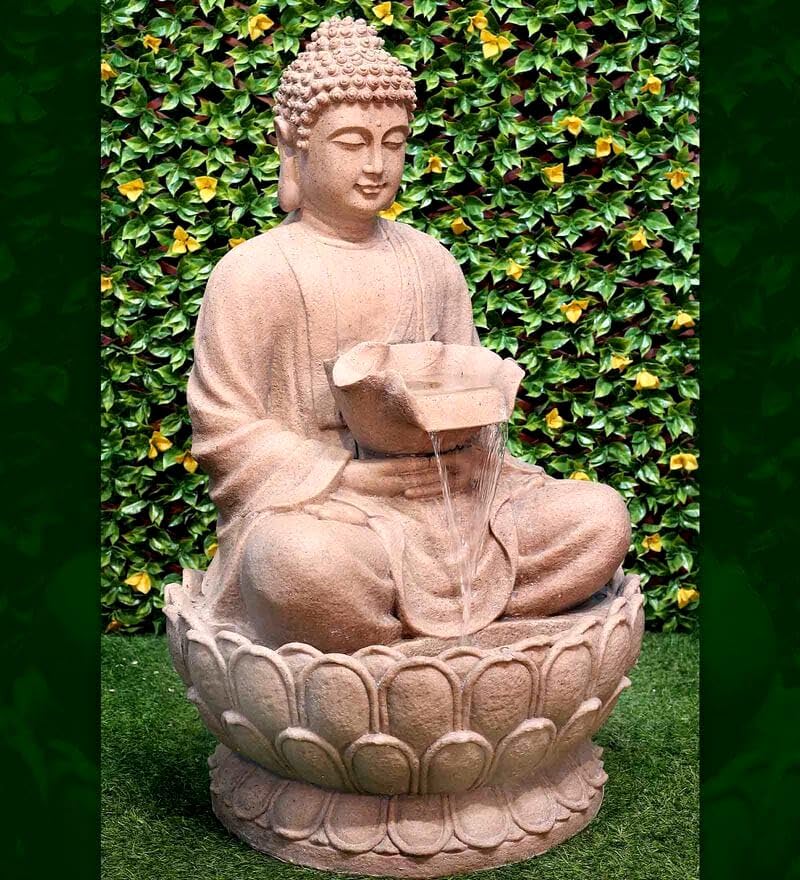
Where to Buy buddha fountain for home garden India
Shopps.in · Fountains & Water Features · May 2026
The Buddha Fountain Guide
Indian Homes Actually Need
Mumbai terrace vs Lucknow courtyard vs Bengaluru balcony. What size, what finish, where to place it, how to keep it running through the monsoon. Real products. Confirmed prices.
Here’s the thing most guides get wrong about buying a buddha fountain for home garden India — they treat it as a décor purchase. Pick a finish that looks good in a photo, order, done. In reality, a fountain is closer to a small infrastructure decision. Where it goes determines whether a pump lasts two years or ten. What size you choose determines whether it reads as a meditative focal point or a garden-centre afterthought. And which finish works in your city depends on whether you are in humid coastal Chennai or dry-season Lucknow.
I have designed or advised on fountains in gardens across fourteen Indian cities over fourteen years. The questions that come up are almost always the same. Size versus space. Indoor versus outdoor. What to do when the monsoon arrives. And the one nobody asks until after purchase: why is the water going green?
This guide answers all of it — city by city.
Choosing a Buddha Fountain for Home Garden India — Size First
This is the decision that matters most and gets skipped most often. People choose finish, style, symbolism — and order whatever size comes with their chosen design. Wrong order. Size governs everything. A fountain that is too large for its space looks aggressive. One that is too small looks like a decorative afterthought. Neither is the calming, soothing anchor you were actually trying to create.
| Fountain Height | Minimum Garden / Space | Best Indian Placement | Price Range (IGST incl.) |
|---|---|---|---|
| Tabletop (12–18 in.) | Any — works indoors too | Console table, balcony shelf, study desk, bedroom corner | ₹11,900–₹17,800 |
| 2 feet (60 cm) | 5×5 ft minimum | Small garden corner, balcony with raised planter, patio nook | ₹12,200–₹16,700 |
| 3 feet (90 cm) | 8×8 ft minimum | Standard Indian courtyard, villa garden, terrace corner | ₹21,838–₹26,840 |
| 4 feet (120 cm) | 12×12 ft minimum | Large property garden focal point, resort-style courtyard | ₹30,900–₹39,900 |
The clearance rule: leave minimum 3 feet of clear space on all sides of a garden fountain. This allows maintenance access (pump cleaning, refilling), prevents the fountain from visually crowding surrounding plants, and ensures the water sound disperses naturally rather than bouncing off walls into a sharp echo.
For apartment terraces in Mumbai, Bengaluru, and Hyderabad — where outdoor area is typically 50–120 square feet — a 2-foot model is almost always the honest answer. A 3-foot fountain on a 60 sq ft Mumbai terrace does not look grand. It looks like it belongs somewhere larger. Honestly, the 2-foot lotus meditating Buddha at ₹12,200 works better in those spaces than anything bigger.
City-by-City — How the Same Purchase Decision Changes
The same 3-foot sandstone Buddha fountain behaves completely differently in Lucknow versus Vizag. This is not about preference — it is about climate, garden culture, and apartment typology. Here is what I have seen across the cities I work in.
Indoor Buddha Water Fountain India — Where It Works, Where It Does Not
An indoor buddha water fountain India placement has different rules than an outdoor one. The sound is amplified by walls. The electrical connection is simpler. The maintenance is more visible — guests will see the fountain, so clarity and cleanliness matter every day.
The three indoor placements that actually work in Indian homes:
Northeast corner of the living room. Vastu-aligned, visually strong — the corner gives the fountain a natural backdrop. A tabletop or 2-foot model on a plinth or corner shelf reads as a curated element rather than placed furniture. Pair it with a small Buddha figure and one indoor plant for a complete meditation corner that takes up roughly 4 square feet.
Entryway or foyer. Low-key amazing impact. Guests walk in, hear water before they see the fountain. The sound shifts the mood of the entire entry experience. Combine with a console table along the wall and a mirror above — the reflected fountain doubles the visual presence without doubling the footprint.
Puja room or meditation space. The most traditional placement. Moving water at the threshold of a puja room is considered auspicious in multiple Indian traditions. A 2-foot fountain with a lotus base — like the ₹12,200 lotus meditating Buddha — is proportioned exactly right for a standard 6×8 foot puja room without dominating the space.
The Products — Confirmed Prices, Honest Descriptions
All prices from the live Shopps.in category page. IGST-inclusive. Free all-India shipping. COD and EMI available. Toll-free: 1800-203-7307.
How to Keep a Buddha Fountain Pump Running for Years
The pump is the only mechanical part of a Buddha fountain. Everything else — the resin body, the finish, the basin — is passive. Get the pump right and the fountain runs indefinitely. Ignore it and the fountain goes silent within 18 months. Here is the complete maintenance sequence used in professional garden installations.
Weekly: Check water level. The pump intake must stay fully submerged at all times. Running the pump dry for even 10–15 minutes causes motor overheating and permanent damage. Top up with distilled or filtered water — tap water works but creates faster mineral scale.
Monthly: Add one capful of fountain water treatment solution (available at garden stores, roughly ₹200–₹400 for a 250ml bottle). This inhibits algae, prevents green water, and reduces mineral scale on fountain surfaces. Also remove and rinse the pump intake filter — the small mesh screen on the pump body. Takes 3 minutes.
Every 3 months: Full drain and scrub. Empty the basin completely, wipe down interior surfaces with a soft brush and mild dish soap. Rinse thoroughly before refilling. This removes the mineral scale and algae film that water treatment alone cannot fully prevent. The pump itself: submerge in plain water and run for 5 minutes to flush internal deposits.
Monsoon protocol: Unplug during heavy rain to protect the outdoor power connection. The fountain body and basin handle rain perfectly — resin is waterproof. The electrical connection is the only vulnerability. Resume once rain stops. Do not drain the fountain during monsoon — the constant refill from rain actually reduces evaporation maintenance significantly.
Sandstone Buddha Fountain Outdoor — Why the Finish Matters More Than the Form
Oh man — the number of buyers who pick the finish last, almost as an afterthought, and then call six months later asking why the fountain looks wrong in the garden. The finish is not cosmetic. It determines how the fountain reads in its environment and how it ages.
A sandstone buddha fountain outdoor placement does something a bronze or dark-finish fountain cannot: it disappears into the garden palette in the best way. Sandstone — warm ochre, sun-baked beige — reads as natural stone from a distance. It looks like it has always been there. Plants grow near it, moss (in humid gardens) develops along the base, and the fountain starts to look like a genuine garden heritage piece within a year or two.
Bronze finishes work differently. They create contrast. Against green foliage, a bronze Buddha reads as an art installation rather than a garden element. This is the right choice when the garden is minimal — gravel, stepping stones, sparse planting — where you want the fountain to assert its presence rather than blend in.
Grey stone finishes are the most contemporary. They pair with modern outdoor design — poured concrete, geometric planters, clean-line garden furniture. Basically the antithesis of the heritage courtyard look, but completely right for Bengaluru or Hyderabad new-villa gardens with contemporary landscaping.
What to Pair With a Buddha Fountain
A fountain alone is a water feature. A fountain in context is a sanctuary zone. In my experience, the pieces that complete the setup most effectively are the ones that share the meditative register of the fountain itself.
A standing or sitting Buddha statue positioned 2–3 feet from the fountain creates a devotional composition rather than a single object. The fountain’s moving water and the statue’s stillness are complementary — one active, one passive. Both calming.
Indoors, a console table under a wall-mount Buddha fountain or alongside a tabletop fountain gives the water feature context. A mirror above reflects the fountain, doubling the visual impact without adding footprint. A metal wall piece — lotus motif or geometric — flanking the fountain completes the wall composition.
In a living room where a centre table or side table is already carrying metallic finishes, a tabletop fountain on the side table continues that language while adding a sound layer to the room. The effect is subtle. But you notice it every day.
Frequently Asked Questions
Safe to say — the buddha fountain for home garden India purchase is one of the few décor decisions that continues to deliver value every day. Not visually alone, but sonically. The sound of moving water changes the baseline atmosphere of a space in a way that a wall clock, a mirror, or a sculpture simply cannot. Get the size right, place it with vastu in mind, maintain the pump monthly, and this is a piece that will outlast most other things you buy for your home.
Toll-free: 1800-203-7307 · All prices IGST-inclusive · Free all-India shipping · COD & EMI available · Browse all 28 fountain designs →