


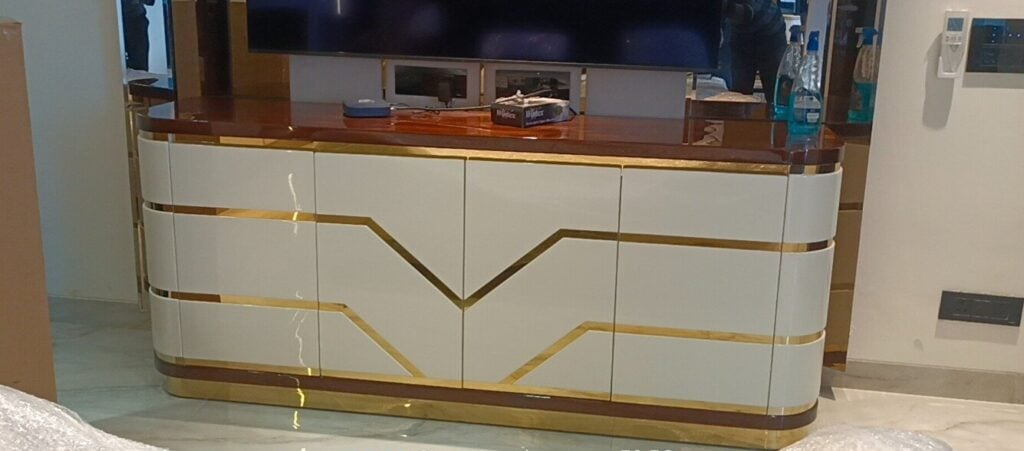
You know the other day I walked into a dining room in Kolkata’s Salt Lake — a well-renovated 3BHK, new build, careful fit-out — and the sideboard against the wall was 180 cm wide. The dining table was 150 cm. The sideboard was wider than the table it was supposed to anchor. The room looked like the wall furniture had swallowed the dining furniture. The family had spent ₹1,10,000 on a piece that made their ₹85,000 dining table look undersized. That’s the real cost of a wrong-sized buffet table sideboard for dining room India — not just the money spent on the wrong piece, but what it does to everything around it.
Twelve years of speccing heritage and luxury furniture in Bengal has given me one consistent obsession: the ratio. Get the ratio right and the room works. Get it wrong and no amount of good décor fixes it. Here is the complete sizing guide nobody publishes for Indian dining rooms — with numbers, not suggestions.
Quick answer: what size buffet table sideboard goes in an Indian dining room?
Your sideboard should be 60–80% of your dining table length and never longer than the table itself. For a standard 6-seater Indian dining table (150–180 cm), the right sideboard is 100–130 cm. For an 8-seater (180–210 cm), aim for 120–150 cm. Height: 80–90 cm — slightly taller than your dining table (75–78 cm) but not dramatically so. Depth: minimum 40 cm for useful storage; 45–50 cm is ideal. Leave 90 cm clearance between the sideboard front and any dining chair in pulled-out position.
The True Cost Breakdown — What Getting It Wrong Actually Does to Your Room
I frame this as a cost exercise because honestly, most people think about sideboards purely aesthetically. But a wrong-sized piece creates cascading problems that cost more to fix than just buying the right size from the start.
This is the Salt Lake mistake. When your sideboard runs wider than your dining table, the visual hierarchy of the room inverts — the wall piece dominates the floor piece. In a dining room, the table should always read as the primary object. A sideboard that outspans it by even 20 cm creates a subliminal wrongness that guests feel even if they can’t name it.
The fix costs you the piece plus redelivery. Prevention costs you five minutes of measuring before ordering. I mean, it sounds obvious written out — and yet I see it constantly across new Indian builds where buyers are ordering furniture from catalogue images on a phone screen without measuring.
A shallow sideboard (under 35 cm) looks slim and compact in a product photo. In actual use, it can’t store a dinner plate standing upright (standard dinner plate diameter: 26–28 cm), can’t fit a full set of glassware lying down, and the top surface is too narrow to actually serve from during a meal. You’ve bought décor, not storage. The minimum useful depth for an Indian dining room sideboard is 40 cm. 45 cm is comfortable. 50 cm is generous.
Shopps.in’s range runs 40–50 cm depth across most products — the Classic Buffet Table Sideboard is specifically built for Indian dinnerware dimensions. Worth checking depth specs before ordering on any platform, not just here.
A sideboard should sit 5–15 cm taller than your dining table. This is the correct visual relationship — the table reads as the floor anchor, the sideboard reads as the wall layer. If your sideboard is the same height as your dining table, the two pieces compete at the same visual plane and the room feels flat. If the sideboard is dramatically taller (20 cm+ above the dining table), it starts reading as a storage cabinet rather than a dining room piece.
Standard Indian dining tables: 75–78 cm tall. Standard sideboard target height: 82–90 cm. The Shopps.in marble top range at 83–90 cm height hits this correctly for most Indian dining configurations.
The gap between a pulled-out dining chair and the sideboard front needs to be at least 90 cm for comfortable movement — someone walking behind a seated guest. In a compact 3BHK Indian dining room (2.5 × 3.5 m), this is the most critical constraint. Work backwards from your available floor area: place your dining table centrally, pull out all chairs, measure the remaining wall space. That remaining measurement minus 90 cm is your maximum sideboard depth. Only then size your sideboard width within the 60–80% of table length rule.
That’s wild how many times I’ve seen this ignored. A sideboard that works perfectly in a 4BHK villa becomes a circulation problem in a standard 3BHK dining room simply because the depth calculation was skipped.
So underrated — the ratio system. Once you apply it, every room makes sense.
The Complete Sizing System — Dining Table to Sideboard Reference
Here is every Indian dining table configuration mapped to the correct sideboard dimensions. All measurements in centimetres.
| Dining Table Size | Seats | Sideboard Length (60–80%) | Sideboard Height | Sideboard Depth | Min. Clearance |
|---|---|---|---|---|---|
| 120 cm table | 4-seater compact | 75–95 cm | 82–88 cm | 40–45 cm | 90 cm |
| 150 cm table | 4–6 seater standard | 95–120 cm | 82–90 cm | 42–48 cm | 90 cm |
| 180 cm table ★ | 6-seater standard Indian | 110–140 cm | 84–90 cm | 44–50 cm | 90–100 cm |
| 200 cm table | 8-seater | 125–160 cm | 84–92 cm | 45–52 cm | 100 cm |
| 240 cm+ table | 10–12 seater / villa | 150–190 cm | 85–92 cm | 48–55 cm | 100–110 cm |
★ Most common Indian 3BHK dining configuration. All Shopps.in prices IGST-inclusive. Free pan-India shipping.
What a Sideboard Actually Holds — Storage Capacity for Indian Dining Rooms
This is the data point nobody publishes. “Ample storage” appears in every product description. Here’s what that actually means in Indian dinnerware terms.
| Sideboard Width | Dinner Plates (26 cm dia.) | Serving Platters | Wine/Water Glasses | Flatware Sets | Table Linen Sets |
|---|---|---|---|---|---|
| 100 cm (2 cabinet) | 16–20 plates | 2–3 platters | 8–10 glasses | Set for 6 | 3–4 sets |
| 122 cm / 48″ ★ | 20–30 plates | 4–6 platters | 10–12 glasses | Set for 8 | 4–6 sets |
| 150 cm (3 cabinet) | 30–42 plates | 6–8 platters | 14–18 glasses | Set for 10–12 | 6–8 sets |
| 180 cm / 72″ | 45–55 plates | 8–10 platters | 18–24 glasses | Set for 12 | 8–10 sets |
★ Most popular Indian purchase size. Figures assume adjustable interior shelves.
Materials — What Actually Holds Up in Indian Conditions
To be fair, this changes depending on where you live. A solid wood sideboard in a Kolkata home needs different care than the same piece in Delhi. Here’s the honest breakdown.
| Material | Monsoon Performance | Maintenance | Visual Quality | Best Indian Context | Shopps.in Option |
|---|---|---|---|---|---|
| Solid Hardwood (Indian) | Good — needs annual oiling | Annual treatment | Exceptional — rich character over time | Dry-climate cities: Delhi, Jaipur, Indore | Classic Buffet Table Sideboard |
| Engineered Wood + Metal | Excellent — stable | Wipe clean | Very good — consistent finish | Any Indian city, all climates | Urban Sideboard Buffet Table |
| Faux Marble Top + SS Frame | Excellent | None | Luxury aesthetic | Coastal: Mumbai, Kochi, Vizag, Chennai | Offwhite Side Board Cabinet |
| Natural Marble Top | Seal annually | Seal + careful use | Unmatched when fresh | Formal dining rooms, low traffic | Marble Top Sideboard range |
| High Gloss Lacquer | Very good | Fingerprints show | Contemporary, dramatic | Bengaluru, Hyderabad — modern builds | Contact for custom finish |
In hindsight, the engineered wood with faux marble top and SS frame combination is the most sensible choice for most Indian 3BHK dining rooms. It handles every climate zone, requires zero maintenance, and visually reads as premium at a glance. The solid hardwood options are for buyers who understand they’re investing in a piece they’ll maintain for decades — heirloom-quality, genuinely artisanal, but requiring a care relationship. Both are valid. The question is which one suits your lifestyle, not just your taste.
The Shopps.in Buffet Table & Sideboard Range
All prices IGST-inclusive. Free pan-India shipping. COD available on select products. EMI available. Call 1800-203-7307 toll-free for sizing and customisation queries. Dispatch: 2–3 weeks standard.
The contemporary workhorse. Clean urban lines, engineered wood frame, metal accent details — handles every Indian climate without maintenance. Fits the 60–80% ratio for a standard 6-seater dining table. Photos don’t do it justice in person.
Shop NowThe heirloom-quality piece. Handcrafted in India using seasoned hardwood, antique-style brushed metal handles. Timeless and genuinely artisanal — every piece carries the character of the wood. Worth every rupee for a formal dining room that will stand for 20 years. Surprisingly sturdy.
Shop NowThe luxury coastal pick. Faux marble top with golden frame — zero maintenance, handles humidity perfectly. Looks even nicer in person than product photos suggest. Everyone who visits the dining room asks about it. Best for warm-palette Indian interiors.
Shop NowThe statement investment. Natural marble tops across a full size range — 3 drawers, 2 cabinets, adjustable interior shelving. Polished craftsmanship and a visual presence that anchors any dining room. Better than expected at this price for the quality of the stone finish.
Browse RangeWhere to Place a Sideboard in an Indian Dining Room — Positioning Guide
Here’s the question silently asked before every sideboard purchase: which wall does it go on? The answer depends on your dining room configuration — not a generic rule.
The longest unobstructed wall is the default. This is almost always opposite the dining table’s short end or perpendicular to it. In a standard rectangular Indian dining room, this means the sideboard sits on the wall you face when seated at the head of the table.
Avoid the window wall unless your sideboard is at least 10 cm shorter than the window sill height. A sideboard that blocks a window cuts natural light to the dining area — in Indian homes where natural light is already a premium, this is a significant quality-of-life compromise.
Avoid the entry wall in compact dining rooms. In an open-plan Indian 3BHK, the dining room typically opens to the living room. A sideboard on this wall creates a visual barrier between the two spaces that can make the combined area feel chopped and smaller.
The perpendicular wall — the wall at a right angle to the dining table’s long axis — is actually the strongest visual placement in most Indian dining rooms. The sideboard becomes a backdrop to the table rather than a competing focal point. And from a practical standpoint, serving is easiest when the sideboard is reachable from the table’s end rather than its side.
Come to think of it, the placement question also determines which direction your sideboard drawers should face. Drawers facing toward the dining table mean serving cutlery is always within reach from a seated position. Worth considering before you orient the piece.
For a complete dining room picture — apply the sizing system to your dining table first, then size the sideboard. The chair range determines your clearance calculation. For the living room wall adjacent to your dining area, the mirror range above a sideboard creates one of the strongest visual moments in Indian open-plan homes. The metal wall decor flanking a sideboard adds the vertical accent layer. And for the foyer leading into the dining room, the console table range creates a natural transition from entryway into dining space. The partition range is worth exploring if you’re defining the dining zone within an open-plan 3BHK layout.
And honestly? No regrets when you measure first. The sideboard that works is the one sized for your actual room — not the one that looked right at 1200 pixels wide on a shopping app.