


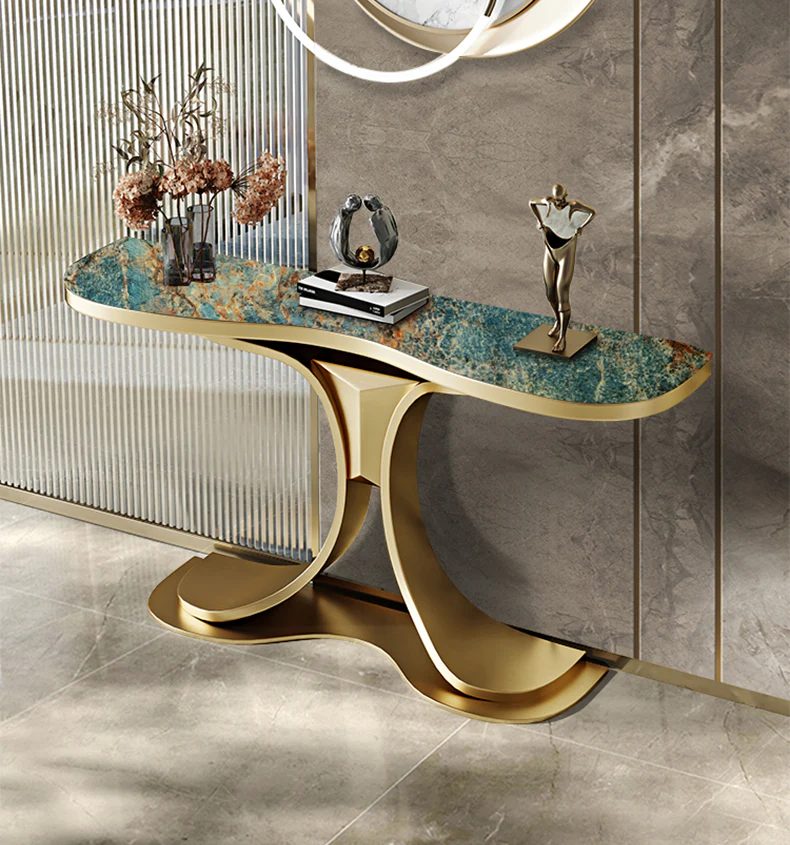
Console Table for Indian Entryway
Shopps.in · Home Décor Guide · May 2026
The Right Console Table
for an Indian Entryway
101 designs. Real measurements. Honest finish comparisons. What works in a 3-foot Indian foyer — and what quietly eats it alive.
Okay, hear me out — the entryway is the room nobody thinks about until a guest arrives. You open the door, and suddenly you see it the way they see it: a narrow strip of floor, maybe a wall that needs something, and a pile of keys, bags, and shoes that have accumulated their own little ecosystem. I have walked into probably two hundred Indian homes over eleven years of consulting. The ones that feel right the moment you step in — almost all of them have one thing in common. A console table.
Not a big one. Not a loud one. Just a narrow, refined surface that gives the entryway a reason to exist beyond being a passage. And honestly? Getting it wrong is just as easy as getting it right. Too wide, the table chokes the walkway. Too ornate, it fights with everything else. Wrong finish, it looks cheap even at ₹50,000.
This guide is about choosing a console table for an Indian entryway — specifically. Not a generic global guide that thinks every home has a ten-foot foyer. Real Indian measurements, real Indian finish considerations, real products with confirmed prices.
Sizing a Console Table for an Indian Entryway
Here is the thing most buying guides skip: Indian entryways are not American foyers. They are typically 3–4 feet wide. That’s 90–120 cm of floor to work with before the rest of the home begins. A console table for an Indian entryway needs to fit inside that spatial logic — or it becomes the piece everyone squeezes past, every single day.
The numbers that actually matter:
| Entryway Width | Recommended Table Width | Max Depth | Clearance Left |
|---|---|---|---|
| 3 feet (90 cm) | 30–36 inches (75–90 cm) | 12 inches | ~18 cm — tight but functional |
| 3.5 feet (105 cm) | 36–42 inches (90–105 cm) | 12–14 inches | Comfortable passage |
| 4 feet (120 cm) | 36–48 inches (90–120 cm) | 14–16 inches | Generous — allows styling |
| Hallway (5+ feet) | 48+ inches | 16–18 inches | Full display table possible |
| Living room wall | Match sofa width ≈ 60–70% | 16–18 inches | N/A — wall placement |
Standard height for a console table is 30–36 inches (76–91 cm). That is basically counter height — comfortable to drop keys on when walking in, easy to reach for bags when walking out. In practice, aim for the 30–32 inch range if anyone in the household is shorter than 5’4″.
Gold vs Rose Gold vs Steel: Which Finish for a Hallway?
This is where most people second-guess themselves for weeks. Actually, the answer is more straightforward than it looks — once you know what each finish is actually doing in the space.
Gold console tables (PVD-coated stainless steel)
Gold is warm. It reflects warm light. In an Indian entryway — which in most apartments gets very little natural light — a gold frame actively makes the space feel brighter and more welcoming. Pair it with a white or beige faux marble top and a mirror above, and the entry glows. Quality feels premium when you run a hand along it. This is the reason gold finishes dominate in Delhi, Chandigarh, and Jaipur homes where warmth and richness are the expected register.
Rose gold console tables
Rose gold is the subtler version of gold — still warm, but softer. It tends to read as more contemporary and less traditional. Bengaluru and Mumbai homes (where the interior palette often runs cooler — white walls, light wood floors) tend to lean towards rose gold because it bridges the gap without committing to full yellow-gold warmth. Worth every rupee if your home already has other rose gold or copper-toned accents.
Stainless steel / chrome
Cooler, crisper, more graphic. Works well in homes with grey or black marble flooring, or in contemporary apartments where the design language is already quite clean and geometric. Pairs naturally with grey-veined marble tops.
| Finish | Best Interior Palette | Light Behaviour | Durability | Typical Use City |
|---|---|---|---|---|
| PVD Gold | Warm white, beige, cream walls | Reflects warm amber light | Excellent — PVD bonded to SS | Delhi, Chandigarh, Jaipur |
| Rose Gold | White, light wood, blush accents | Soft warm glow | Excellent — PVD bonded to SS | Bengaluru, Mumbai, Pune |
| Stainless / Chrome | Grey, black, cool white | Crisp, sharp reflection | Excellent — no coating needed | Hyderabad, Chennai, NCR modern |
| Matte Black | Any — very versatile contrast | Absorbs light — dramatic | Good — powder-coated | Contemporary apartments all cities |
To be fair — the PVD coating question comes up every time. PVD stands for Physical Vapour Deposition. It bonds the finish at a molecular level to the stainless steel. Unlike electroplating (which sits on top and eventually peels), PVD is essentially part of the metal. Shopps.in’s gold and rose gold frames use PVD. That matters in Indian conditions — humidity, damp mopping, and the occasional accidental splash from monsoon season.
Faux Marble vs Natural Stone — What You Are Actually Getting
Photos honestly don’t do it justice — and that cuts both ways. Faux marble tops can look far more premium in person than online photos suggest. Natural marble can look less consistent than a perfectly lit product shot implies.
For an entryway specifically, faux marble (engineered stone) has real functional advantages. It is lighter, which matters when you are assembling a table by yourself. It resists staining better — a key consideration when keys with dirty fobs, bags from outside, and the occasional deliveryman’s wet package land on it daily. And it will not etch if someone puts a wet glass on it (natural marble is vulnerable to acids, including the ones in water from municipal supply).
Natural marble is for living room display pieces in homes with carefully managed traffic. For a marble top console table India in an entryway, faux marble is the pragmatic and honest choice. Unless a Shopps.in product page explicitly says “natural marble,” the top is faux — and that is a genuine advantage, not a compromise.
The Products — Confirmed Prices, Real Descriptions
All prices below are IGST-inclusive. Free all-India shipping on every order. COD and EMI available. Toll-free: 1800-203-7307.
Three Placements — Entryway, Hallway, Behind the Sofa
A gold console table hallway placement works differently from an entryway placement. Here is how to think about each.
The entryway (3–4 feet wide)
Depth is the enemy. Stay at 12–14 inches maximum. Place the table against the wall directly opposite or to the side of the front door — never in the door swing path. A mirror above completes the setup: guests see themselves before leaving, the space feels twice as deep. The surface holds: key tray, one lamp, one object. That is all. Resist the urge to add more.
The hallway (long corridor, 5+ feet wide)
Here you have room. 16–18 inch depth is possible without choking traffic. A longer table (48+ inches) anchors the visual midpoint of a corridor. Symmetrical styling — matching lamps at each end, centred artwork above — works here in a way it cannot in a tight entryway. The radiant reflective surface of a gold or rose gold frame bounces light along the corridor, making it feel warmer and less institutional.
Behind the sofa (living room)
This is the most underused placement in Indian homes. A narrow console table Indian home positioned directly behind the sofa — height matching the sofa back, or 2–3 inches lower — creates a visual boundary in open-plan living rooms and adds a surface for lamps without requiring a dedicated side table. Match width to 85–100% of sofa length.
What Goes With It
A console table works best as part of a considered setup, not as an isolated purchase. In hindsight, the most common mistake I see is buying the table but skipping the pieces that give it context.
A mirror above a console table is non-negotiable in an entryway. The reflected depth doubles the perceived space. A wall clock on an adjacent wall gives the entryway a functional anchor. If the living room console is behind a sofa, a pair of metal wall decor pieces on either side creates a gallery-inspired triptych. Pair the console surface with a small tabletop fountain — the calming sound of water at the entry changes how people feel walking in. And for the living room itself, the console table pairs naturally with a centre table and side tables that continue the metallic finish language.
If you are furnishing the full entryway zone, also consider a partition to separate entry from living room — particularly in open-plan apartments where the front door opens directly into the main living space. A laser-cut steel partition at the entry threshold creates defined zones while continuing the metal aesthetic of the console table.
People Also Ask
Anyway, that’s my take. The entryway is five seconds of experience that shapes how the whole home feels. A console table is the single piece that can give those five seconds a point of arrival. Pick the right size, pick a finish that continues into the rest of the home, and don’t overcrowd the surface. The negative space around a well-chosen piece is part of what makes it work.
Toll-free: 1800-203-7307 · All prices IGST-inclusive · Free all-India shipping · COD & EMI available.