


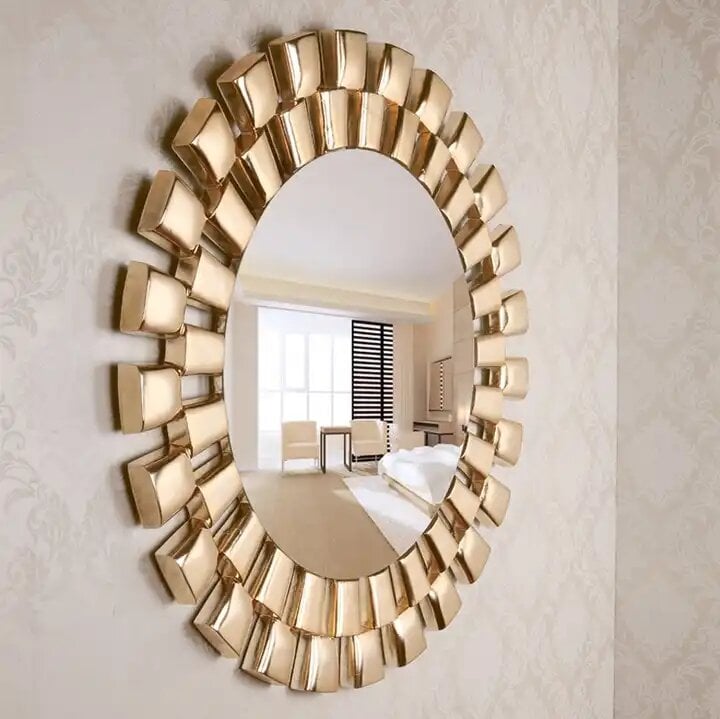
Okay, hear me out — the console-and-mirror pairing is one of those things that looks effortless in every magazine spread and impossibly complicated when you’re actually standing in your own foyer trying to figure out what size mirror to hang, how high to go, and whether your gold frame is going to fight with your terracotta walls. I’ve been working with heritage and luxury interiors in Jaipur for eleven years, and honestly, the venetian mirror above console table India combination is the single most under-documented pairing in Indian home décor. Everyone talks about “statement mirrors” in isolation. Nobody talks about the math, the proportion, the palette logic — in context of actual Indian ceiling heights and actual Indian console table dimensions.
So this is that guide. All of it. Step by step. No vague “measure your wall and trust your eye” advice — real numbers, real products, real rooms.
Quick answer: how high does a Venetian mirror hang above a console table?
Leave 15–20 cm of wall between the console tabletop and the bottom of the mirror frame. For Indian standard ceiling heights (9–10 feet), aim to centre the mirror at 155–165 cm from the floor — roughly eye level. On an 80 cm tall console, that puts your mirror’s lower edge starting at 95–100 cm. Width rule: mirror should be 70–80% of the console table’s width. This ratio creates visual balance without the mirror overwhelming or being swallowed by the table beneath it.
The 6-Step One-Room Challenge: Building the Perfect Console + Venetian Mirror Foyer
Come to think of it, most people approach this backwards — they buy the mirror first and then try to match a console to it. I’ve seen this create every kind of proportion problem. The correct sequence is below, and it makes the whole thing genuinely straightforward.
Before any product browsing at all, measure the wall width you’re working with and your floor-to-ceiling height. Indian standard 3BHK foyers typically run 90–140 cm wide with 9–10 foot ceilings. Note that number. It determines everything downstream — console width, mirror width, and how much visual “stack” the combination can carry without looking top-heavy or too sparse.
In Jaipur’s older havelis and even newer premium builds, I often see 10–11 foot ceilings. That’s actually ideal for a tall arched Venetian mirror with a curved top — the extra vertical space gives the crown room to breathe.
For a foyer or hallway console, standard Indian sizing runs 100–120 cm long × 35–40 cm deep × 78–85 cm tall. Shopps.in’s console table range has several options in this footprint. The depth matters — a console shallower than 30 cm feels precarious and makes tabletop styling awkward. Deeper than 45 cm starts encroaching on walking space in typical Indian corridor foyers.
This is the number nobody publishes clearly, so: your mirror should be 70–80% the width of your console table. On a 100 cm console, that’s a 70–80 cm mirror. On a 120 cm console, an 85–95 cm mirror. The Venetian Mirror Premium at 91 cm wide works perfectly with a 110–120 cm console. The Golden Venetian Mirror at a similar scale pairs well with most standard foyer consoles in Indian 3BHKs.
Going narrower than 65% makes the mirror look like an afterthought. Going wider than 90% of the console makes the whole arrangement look like the wall is eating the table.
Mark a point 15–20 cm above your console tabletop — this is where the bottom of your mirror frame should sit. Below this and the mirror feels like it belongs to the table, not the wall. Above 25 cm and the gap creates a dead zone that breaks the visual connection between the two pieces. I mean, this sounds like a small detail but it’s genuinely the difference between “intentional” and “approximate” — and clients always feel it even when they can’t articulate why.
Here’s where Indian interiors have a real advantage: our palette tradition is warm. Terracotta, cream, warm teak, brass, ochre — these all harmonise naturally with a gold-framed Venetian mirror. The hand-etched glass picks up the warm tones from ambient lighting and creates a luminous, golden-toned quality in the evening that simply doesn’t work the same way under cool white LED light.
The Venetian Ruby Empress Mirror — with its arched crown and crimson glass accents — is a particularly good call for espresso-toned interiors or homes with deep jewel-toned accent walls. The ruby panels catch warm light in a way that’s sort of mesmerising, actually.
The console surface below the venetian mirror should follow the three-object rule: one tall item (a lamp, a slim vase, or a tabletop fountain), one medium item (a decorative bowl, a Buddha figure, or a tray with keys), and one low item (a book, a small clock, or a candle holder). The height variation creates rhythm. Matching materials — if your mirror frame is gold, bring one gold-toned object to the tabletop — ties the entire vignette together.
To be fair, a well-chosen Venetian mirror does a lot of the heavy lifting on its own. It reflects the room, doubles the perceived light, and creates depth that makes even a plain white foyer feel like a considered space. But yeah — the tabletop styling is what takes it from “mirror on wall” to “actual interior design.”
So underrated, this pairing. Once you get the proportions right it just works.
The Shopps.in Venetian Mirror Range — Size Guide & Honest Takes
All prices below are IGST-inclusive. Free pan-India shipping on all mirrors. EMI available. COD not available for mirrors — call 1800-203-7307 for queries.
| Product | Size | Price (IGST) | Frame Style | Best Console Width | Room Fit |
|---|---|---|---|---|---|
| Venetian Premium Mirror | 91 × 61 cm (3×2 ft) 122 × 76 cm (4×2.5 ft) |
₹22,000–₹36,300 | Classic etched border, gold | 110–150 cm | Living room, master bedroom |
| Venetian Ruby Empress | 48 × 30 inches (122 × 76 cm) | ₹23,990 | Arched crown, crimson glass, hand-etched | 130–160 cm | Grand foyer, drawing room |
| Golden Venetian Mirror | Standard (see product page) | ₹23,700 ₹39,900 | Classic gold Venetian frame | 100–130 cm | Foyer, dining room wall |
| Royal Indian Mirror | Custom available | ₹36,300 | Heritage Indian motif, ornate gold | 120–160 cm | Formal living room, heritage interior |
| Bolinger Band Mirror | Standard (see product page) | ₹17,900 ₹33,900 | Band/strip Venetian frame, modern edge | 90–120 cm | Bedroom, compact foyer |
| Fantastic Mirror | Customisable, base 3×2 ft | Contact for price | Full Venetian etched frame, rectangular | 110–140 cm | Living room, bathroom vanity |
That’s wild — the Ruby Empress at ₹23,990 IGST for a hand-etched arched mirror with crimson glass accents. No way you find that finish for that price anywhere else in India.
Hand-etched, bespoke, distortion-free glass. The arched crown makes this work above a taller console — it fills vertical wall space in a way rectangular mirrors simply can’t. Looks far more premium in person. Pairs with deep-toned or jewel-palette interiors.
Shop NowThe timeless one. Classic gold Venetian frame with etched border — works with cream, terracotta, warm grey walls. Worth every rupee for the warmth it brings to a foyer. Everyone who visits notices it first.
Shop NowTwo sizes, one timeless design. The larger 122 × 76 cm option is the artisanal statement piece for a formal living room or drawing room console. Surprisingly sturdy — the glass quality is noticeably superior to lower-priced alternatives.
Shop NowThe entry point for a contemporary Indian home that wants Venetian character without full ornate framing. Low-key amazing above a compact console in a bedroom or a narrow corridor. Better than expected for this price bracket.
Shop NowMirror Sizing Guide for Indian Room Types — Quick-Reference
Here’s the question every Indian buyer is silently asking: “Given my actual room type, what size mirror actually fits?” Here’s an honest answer by room.
| Room Type | Typical Indian Dimensions | Ideal Mirror Width | Ideal Mirror Height | Recommended Product |
|---|---|---|---|---|
| 3BHK foyer/entrance | 90–140 cm wide wall section | 60–90 cm | 80–100 cm | Golden Venetian / Bolinger Band |
| Living room accent wall | 180–280 cm wide | 90–122 cm | 100–130 cm | Venetian Premium (large) / Royal Indian |
| Formal drawing room | 240–320 cm wide | 100–130 cm | 120–150 cm | Ruby Empress / Royal Indian Mirror |
| Master bedroom above dresser | 100–150 cm wide | 70–100 cm | 80–120 cm | Venetian Premium (small) / Bolinger Band |
| Dining room side wall | 150–200 cm wide | 80–110 cm | 90–120 cm | Golden Venetian / Fantastic Mirror |
What Makes a Venetian Mirror Worth the Price in India — Honest Breakdown
In hindsight, the question I get most from clients before they commit is: “I can get a plain mirror for ₹3,000 at a local shop. Why does this one cost ₹22,000?” Fair question. Here’s the actual answer.
Venetian mirrors are made from a specific category of glass — originally from the island of Murano in Italy — that has a slightly different light-transmission quality than standard float glass. Indian artisanal reproductions use premium-grade glass with a similar approach to the etching and silvering process. The hand-etching on the border is done by craftspeople, not machines — which means each piece carries slight variations in the etching depth and pattern. That variation is actually the point. It’s what gives the mirror its luminous, slightly shimmering quality. Seriously, no photograph captures it accurately. You have to see it in real ambient lighting to understand what the fuss is about.
On top of that, the frame construction on a quality Venetian mirror uses glass-on-glass — surrounding mirror panels that also catch and reflect light — rather than wood or plastic moulding. That’s why the whole piece seems to glow in a warm room. You can feel the craftsmanship when you handle it. It’s not furniture-grade weight. It has a substance to it.
And honestly? No regrets when you see one properly placed above a console in a well-lit foyer. It quietly transforms the whole room in a way no other single piece can.
Venetian Mirror Care in Indian Conditions — Pre-Monsoon Notes (2026)
Apparently, this is another thing nobody writes about for the Indian context. Venetian mirrors have a silvering layer that can degrade with sustained humidity — specifically, the edges are the most vulnerable. Before monsoon season, a few quick steps protect your investment over years:
Keep the mirror away from walls that develop condensation. In humid cities (Mumbai, Kochi, Chennai, Vizag), ensure the room gets ventilated through the day. Wipe the glass surface with a soft, dry microfibre cloth — avoid any spray cleaner directly on the etched border panels, as chemical residue can cloud the edge detailing over time. The frame glass panels on a quality Venetian mirror are more durable than they look — basically, treat them with the same care as the central mirror glass and they’ll last decades.
For foyer placement specifically — which tends to catch dust from doors — a weekly dry-wipe keeps the etching crisp and the frame panels shimmering. That’s it. Genuinely that simple.
Also worth exploring as you build out the console styling: the console table range at Shopps.in, the metal wall decor for flanking accent pieces, and the Buddha statue collection for tabletop vignette objects. The clock range is particularly good for a console styling layer — a sculptural clock sitting beside a Venetian mirror creates a classic formal-meets-modern pairing that works across Indian interior styles. And if you’re pairing a mirror with a room divider setup, the partition range is worth combining with a mirror for a foyer that genuinely stops guests at the door.
But yeah — start with the mirror height and work outwards. Get the proportions right and everything else follows.