


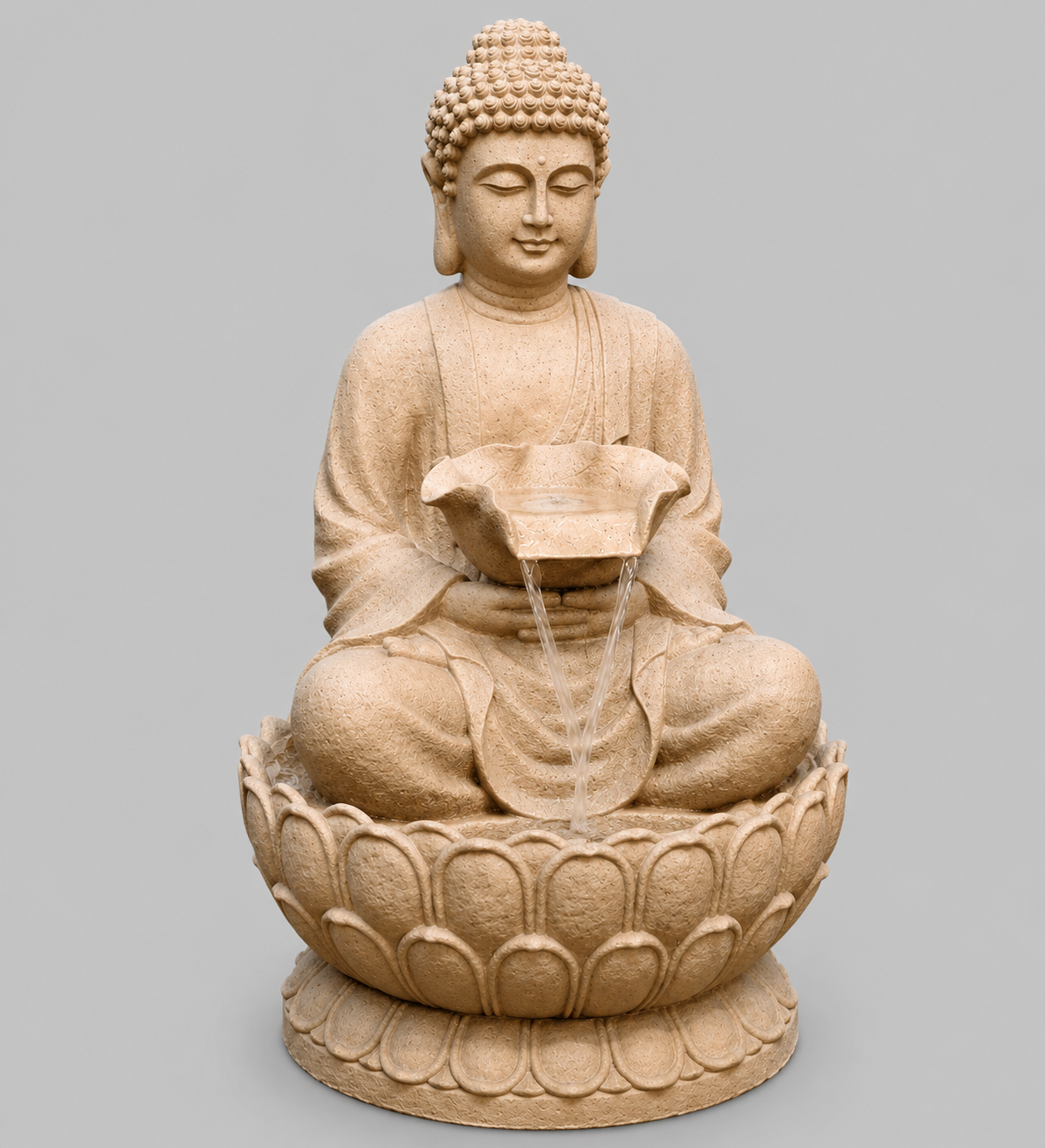
Bowl Buddha fountain
Original price was: ₹97,000.00.₹41,990.00Current price is: ₹41,990.00. IGST
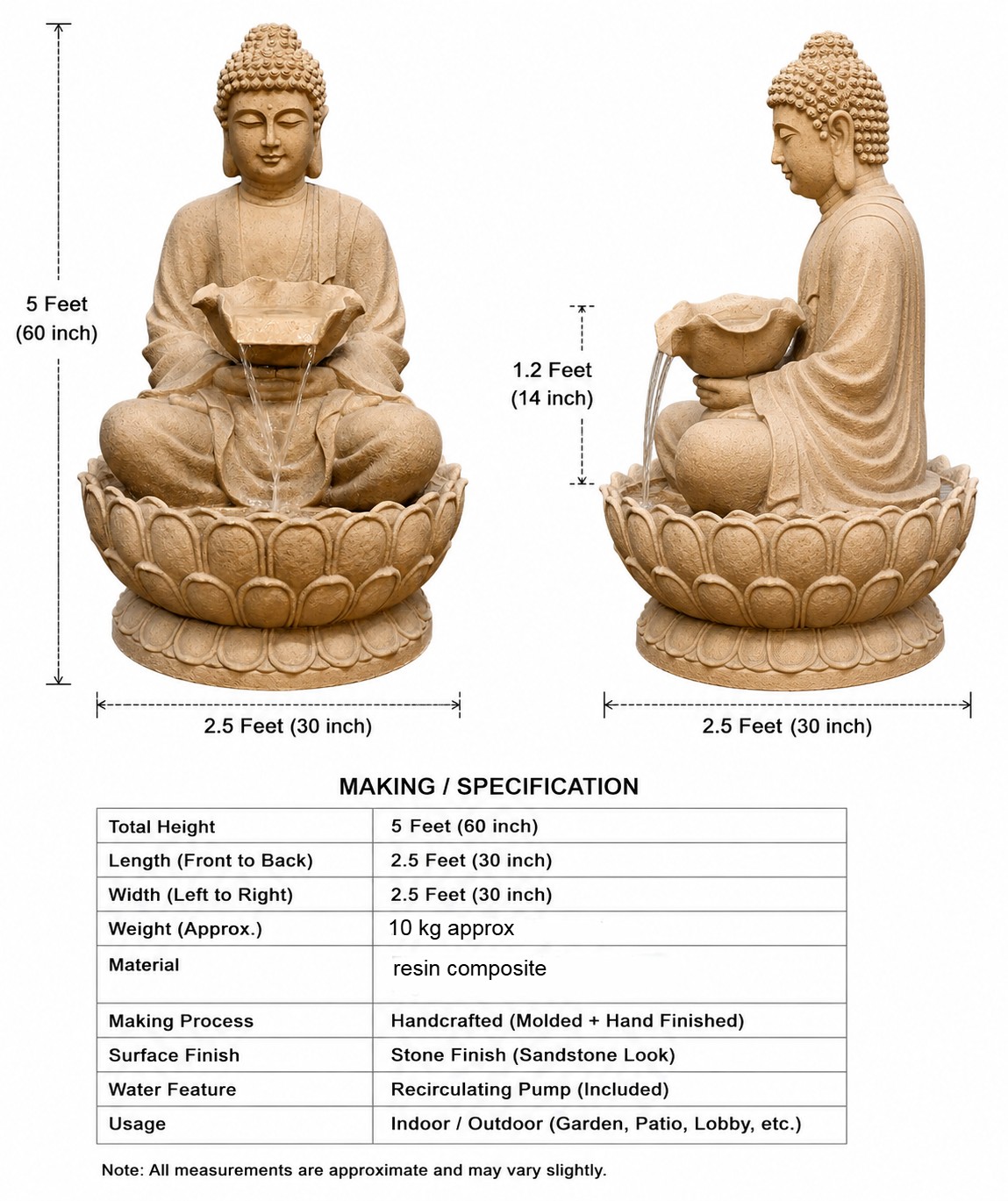
Discover the Bowl Buddha Fountain in sandstone . Water flows from Buddha’s bowl into a lotus below, creating a stunning focal point for modern Indian homes. This is a lovely resin composite Fountain with flowing water feature and sandstone . Perfect for living rooms, entrances, meditation spaces, and luxury interiors.
- 5 feet Buddha statue
- water fountain
- lights available
- 2 weeks despatch
- all India home delivery
Bowl Buddha Fountain: When Stillness Learns to Move
Most Buddha statues are silent.
They sit in corners, on consoles, beside entryways, or in carefully curated meditation rooms. They become part of the background over time—beautiful, meaningful, but static.
The Bowl Buddha Fountain changes that relationship completely.
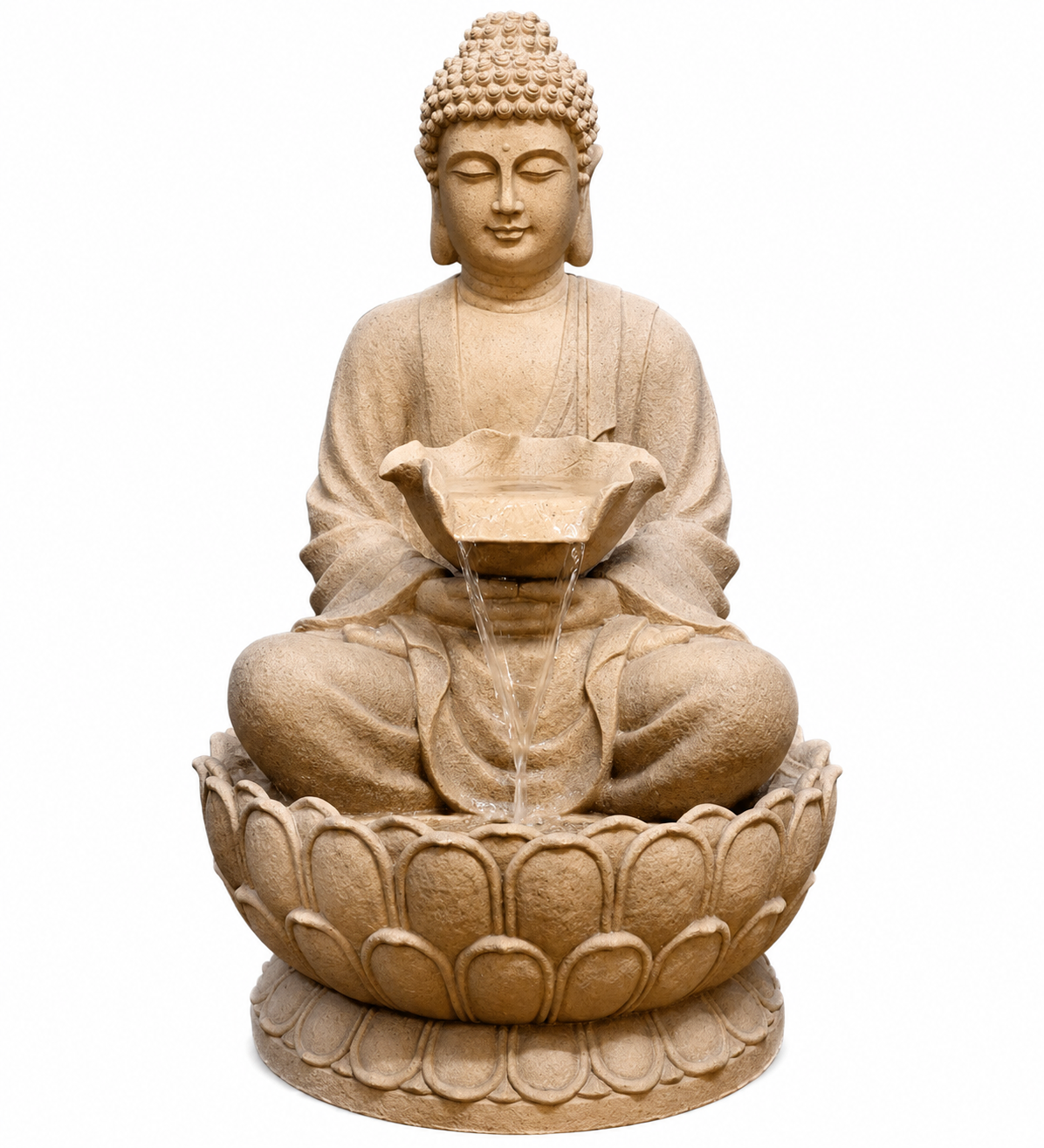
At first glance, it appears to be a sculptural sandstone Buddha figure holding a bowl in its hands. The design feels contemporary rather than traditionally ornate. There are no excessive embellishments, no distracting gold highlights, and no unnecessary decorative details competing for attention.
Then the water begins to flow.
A gentle stream emerges from the bowl and falls into the lotus positioned below, creating a continuous movement that instantly transforms the sculpture from an object into an experience.
Unlike conventional water fountains that often focus on dramatic cascades or multiple tiers, this design revolves around a single visual journey. Water leaves the bowl, travels downward, and finds its destination in the lotus beneath. The movement is simple, but that simplicity is exactly what makes it captivating.
The contrast between the sandstone and the reflective water creates an effect that changes throughout the day. Morning light reveals subtle contours in the Buddha’s form. Evening lighting highlights the movement of water instead. At night, the fountain becomes less about the sculpture and more about the sound.
That sound deserves attention.
Many decorative fountains create a noisy splash that becomes tiring after a few hours. The Bowl Buddha Fountain produces something softer. The water falls a short distance before reaching the lotus, creating a gentle rhythm rather than an overpowering waterfall effect. It becomes part of the room’s atmosphere instead of demanding constant attention.
This is one of the reasons interior designers increasingly use statement fountains as focal points in modern homes.
Large living rooms often suffer from a strange problem: everything is beautiful, but nothing feels alive. Marble surfaces, luxury furniture, designer lighting, and premium finishes can sometimes create spaces that look impressive yet feel motionless.
Flowing water introduces an element that no material can replicate.
The eye naturally follows movement. Guests entering a room notice it immediately. Even after the initial impression fades, the fountain continues to add a subtle sense of activity to the space.
The sandstone finish plays a significant role in this effect.
sandstone has become one of the defining colours of contemporary interiors. It works alongside marble, wood, concrete, metallic finishes, and natural stone without appearing dated. Unlike bright metallic finishes that can dominate a room, sandstone tends to anchor a space.
The result is a Buddha fountain that feels modern enough for contemporary apartments while remaining appropriate for traditional homes.
Many homeowners place Buddha fountains near entrances because the moving water creates a welcoming visual feature for visitors. Others position them in living rooms where the fountain becomes a conversation piece. Some prefer dedicated meditation corners where the continuous flow helps establish a calm environment.
Interestingly, the Bowl Buddha Fountain often attracts attention even from people who do not actively collect spiritual décor.
The reason is simple.
It succeeds first as sculpture and second as symbolism.
Even without considering its spiritual significance, the composition works visually. The proportions between the Buddha figure, the bowl, and the lotus create a balanced design. The flowing water adds motion without overwhelming the overall form. The sandstone finish provides contemporary appeal without chasing temporary trends.
Good décor pieces often reveal themselves slowly.
You notice the silhouette first.
Then the texture.
Then the way light interacts with the surface.
Then the sound.
Then the movement.
The Bowl Buddha Fountain follows this pattern naturally. Every day spent with it reveals another small detail that may have gone unnoticed before.
Perhaps that is what makes the design memorable.
It is not trying to be the largest fountain in the room.
It is not trying to be the brightest object in the house.
It does not rely on excessive decoration to attract attention.
Instead, it creates interest through contrast—stillness and movement, matte surfaces and reflective water, sculpture and sound.
In a world filled with décor that constantly demands attention, there is something refreshing about a piece that earns it gradually.
The Bowl Buddha Fountain does exactly that.
It stands quietly.
The water continues to flow.
And somehow, the room never feels quite the same again.
Related products
-
Price range: ₹8,900.00 through ₹11,300.00Select options This product has multiple variants. The options may be chosen on the product page
Whatsapp
-
Price range: ₹8,900.00 through ₹11,300.00Select options This product has multiple variants. The options may be chosen on the product page
Whatsapp
-
Price range: ₹8,900.00 through ₹11,300.00Select options This product has multiple variants. The options may be chosen on the product page
Whatsapp
-
Price range: ₹8,900.00 through ₹11,300.00Select options This product has multiple variants. The options may be chosen on the product page
Whatsapp

Reviews
There are no reviews yet.